Who was the productivity coach looking for a messaging strategist for coaches?
Meet Polina from Monthly Method. She’s a productivity coach with a really cool Agile-inspired framework that helps online entrepreneurs actually get stuff done without the overwhelm.

She’d proven her method worked through one-on-one coaching and had launched a membership called the Focus Room. But her sales page wasn’t converting consistently. And with a small email list of around 600 people, she needed to maximise every single person who landed on that page.
She found me through Google (yay for SEO!), and when I looked at her sales page, I could see almost immediately why it wasn’t working.
Why did Polina need a messaging strategist for coaches?
There were two problems on her sales page:
First: She was using a lot of jargon. Product management terms, Agile methodology, Scrum Boards—all the technical language that her ideal client didn’t really understand or connect with.
Second: The language on the sales page also felt quite vague. Not specific enough to make someone think, “This was made for me.”
And there was a reason for that vagueness.
When we had our strategy session, it came out that Polina was trying to speak to a bunch of different types of people on one sales page. She hadn’t given herself permission to narrow down and pick one specific person to focus on.
Because her program had attracted a lot of different people in the past – authors, students writing their dissertations, doctors running their own private practices – she felt like her program was for everyone.
So I asked her two questions to help:
“Who do you enjoy working with the most?”
“Who do you get the best results for?”
The answer came immediately: Online entrepreneurs and small business owners.
She was one herself. She understood their problems—the overwhelm, the shiny object syndrome, not knowing what to focus on each day, constantly swapping priorities and losing momentum. She felt the most connected to helping them because she’d lived it.
And she had way more tools for them. She could share things she’d always wanted to share but couldn’t when her membership was full of people in regular 9-to-5 jobs.
Once we narrowed in on that audience, everything clicked into place.
Polina also knew that while she was an expert in productivity coaching, figuring out how to position her offers and communicate their value wasn’t her zone of genius. And she didn’t want to spend years figuring it out when she could hand it to someone who’d already mastered it.
So she hired me to help her refine the positioning and messaging for two offers: her one-on-one coaching and her Focus Room membership. We started with the membership first.
How I supported Polina
The Strategy Session: Getting Clear on Who She Actually Wanted to Serve
We started with a strategy session to map out exactly who Polina wanted to work with and what her ideal client actually needed to hear.
This is where the breakthrough happened. For years, Polina had been stuck thinking she should work with anyone who would pay her. Everyone paid—people from all different backgrounds and situations. But when I asked her, “Who do you enjoy working with most?” she finally gave herself permission to choose.
Small business owners and entrepreneurs. That’s who she had the most tools for. That’s who she could help the most. And that’s who she wanted to show up for every day.
Creating a Signature Framework That Tells a Story
One of the most powerful things we did was create a signature framework for Polina’s program—one that connected directly to her own experience and made the entire offer feel cohesive.
During our conversations, Polina mentioned her experience in college when she joined a secret writing club. In that room, everyone put their phones away, eliminated distractions, and just got work done. It was simple, focused, and incredibly productive.
That became the foundation for her entire offer story: We need to simplify in order to be productive. Less distraction, fewer tabs open, less noise.
Her membership wasn’t just about productivity systems—it was about creating that same focused environment she experienced in that college writing room. A place where entrepreneurs could cut through the chaos and actually make progress.
That’s how the “Focus Room” got its name. And that’s how we built the narrative throughout her entire sales page—showing her ideal clients that what they needed wasn’t another complicated framework, but a simplified space where they could finally focus.
Translating Jargon Into Language That Actually Resonates
The other major shift we made was taking all of Polina’s technical language and transforming it into words her ideal clients were already using.
She was talking in Agile and Scrum terminology. Her clients were talking about overwhelm and getting stuck.
Here’s what that transformation looked like:
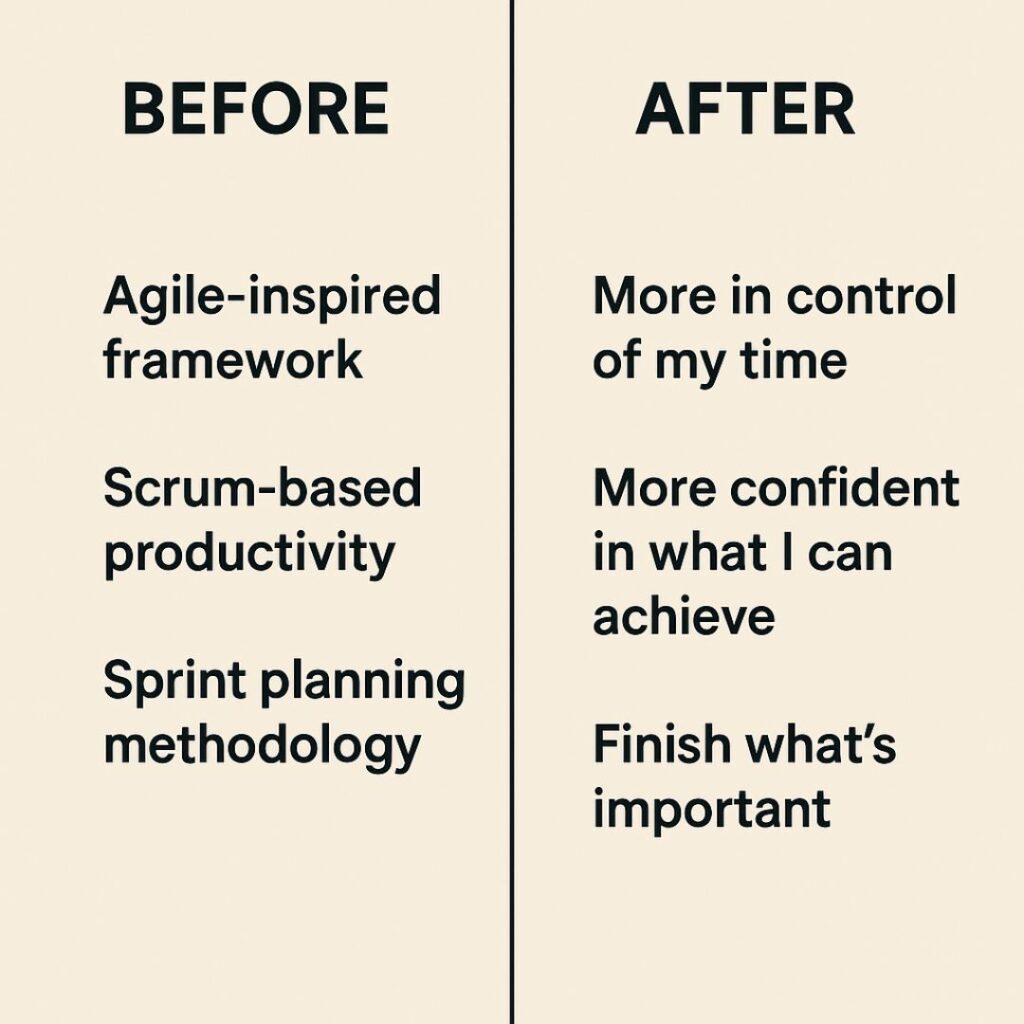
This wasn’t about dumbing down her expertise—it was about speaking to what her clients actually cared about. They weren’t buying Agile methodology. They were buying relief from chaos.
Getting Into Her Ideal Client’s Head
Once we refined who she was talking to, I did market research to really get into their minds.
I wasn’t just looking at surface-level pain points. I was looking for the story that was happening in their heads. The internal narrative they were living.
Anyone can list problems on a sales page. But if you want to create a sales page that actually converts, you need to tap into the story your ideal client is already telling themselves about their situation.
For Polina’s entrepreneurs, that story was about feeling overwhelmed, having a million things pulling at their attention, constantly switching focus and losing momentum, and desperately wanting clarity on what to actually work on each day.
Turning the New Positioning Into Sales Messaging
Once we’d nailed down who Polina’s membership was really for, what made it different and why people needed it, I brought everything together in her Focus Room landing page.
I used what I call an “offer story” — a narrative that runs through the entire page, showing how the offer fits naturally into the story her ideal clients are already living.
This isn’t about adding a nice “about me” origin story at the top. It’s about connecting the problems they’re experiencing, the results they want and the unique way your offer helps them get there.
When you get that right, people don’t have to work so hard to understand why they need your offer. They can see how it fits into their lives, why it’s different from everything else they’ve tried and why it’s worth paying for.
Bringing the New Messaging Into Her Launch
Of course, having a well-positioned offer and a great sales page is only half the equation. You also need to get people TO that page and give them enough reasons to buy.
Polina wanted to write her own launch emails, so I gave her a strategic outline to follow and recorded a Loom video showing her how to use it alongside her new sales page in ChatGPT to write her emails.
Before working with me, she was only sending 2 or 3 emails per launch. I showed her how to structure a full 7-email launch sequence that spoke to different buyer motivations, addressed objections and reinforced the value of her membership.
This also removed her mental barriers around how many emails to send and what to say in them.
And because we’d already done the hard work of clarifying her positioning and messaging, she wasn’t starting from scratch every time she sat down to write an email.
She had a clear understanding of who she was speaking to, what they cared about and why her membership was the right solution.
Plus, she could reuse the same launch structure again and again, simply changing the angles to keep things fresh.
This was another important part of her successful launch. We hadn’t just made her membership easier to understand and more desirable. We’d also given her a better way to communicate that value throughout her launch.
How did the results stack up?
The Numbers:
- Doubled the number of members in her membership on the very first launch after the new copy went live
- Same email list, same audience, completely different results
- Her most successful enrollment since launching the program three years earlier
- Structured her launch email campaign strategically (we overhauled her email approach too)
The Transformation (The Stuff That Actually Matters):
But the numbers only tell part of the story.
The people who enrolled were exactly the right people. Small business owners, creators, and entrepreneurs—the exact audience we’d decided to focus on.
For the first time, Polina felt genuinely excited to create content for her membership because she finally had her people in the room. She could share all the tools and frameworks she’d been holding back on. She could be herself and not “play small” trying to remember what it was like to have a 9-to-5 job.
And after years of struggling with “picking a niche,” she finally had clarity and peace about who she was meant to serve.
As Polina said during our follow-up call: “I feel a lot more liberated to share some of the things… I feel more motivated and excited to kind of show up and share some things.”
View the live landing page here
Now let’s hear from Polina:
“When I was trying to grow the membership, I was trying to explain things in very technical terms, as if I was talking to another product manager, as if people knew what Agile is, as if people were as excited about Scrum Board as I was. Sheryl helped me realize that people actually are looking for other things, like reducing overwhelm, getting clarity on what they want to work on, removing any confusion they might feel, getting unstuck. That’s the things people care about, not the things that I was trying to tell them. My tools help them solve for those things, but I shouldn’t be writing about them on my sales page.”
“It was probably the biggest investment I’ve done in this part-time business of mine to this date. What helped me to make this investment was that I was thinking that I will either have to become a sales expert, a copywriting expert, and I have to invest years into learning this knowledge, and I don’t have time to do that. I had to pick what I want to be good at… I picked to become good at teaching, becoming good at explaining difficult frameworks, becoming good at helping people apply those abstract frameworks into their own lives.”
“What was the most interesting and unexpected side effect from working with Cheryl was that she helped me actually pick the person I want to help. I’ve been struggling with this thing… I thought that if the framework is helpful for everyone, then I should work with anyone who is willing to work with me. But then Sheryl asked me this question, she was like, but who do you enjoy working the most? Then another question, who do you think you can help the most? That was such an aha moment for me.”
“She wrote a copy for my sales page that was so tailored towards small business owners, entrepreneurs, creators, the type of problems that they face, a lot of overwhelm, confusion, small fires burning all the time, and being stuck. So the copy that she wrote was really good, there were very few minor adjustments that were made.”
“The first enrollment that happened after the new copy went live doubled my membership. But what’s more important to me is the type of people that came on board. They were so aligned with the perfect client that we picked when discussing the sales copy. They were small business owners, creators, entrepreneurs, people who are doing their own thing. And as a result, I felt like I could share the tools that I have in my own toolkit. I felt a lot more inspired to post content inside the membership. I felt like I have so much to share.”
“I am very grateful for the service that I’ve received. It really exceeded my expectations. Thank you, Cheryl.”
Ready to get more people to say YES to your program?
I’ve worked as a copy coach inside some of the most established marketing programs, and the funny thing is, whenever a coach was struggling to sell an offer that got great results, the problem was almost always the same.
Their offer wasn’t designed to scale.
And I’m not talking about group calls, a community or recorded trainings.
I’m talking about whether your offer is:
- Easy to understand? Can someone immediately see what it does for them?
- Easy to explain? Can you tell someone what you’re selling without needing a 20-minute conversation?
- Different enough to stand out? Can people see why they should choose your program over all the other options?
- Solving a problem people will pay to fix? Not just something they’d like help with, but something they actually want to spend money solving.
This is what I help coaches figure out and fix.
Through my Designed To Scale consultancy package, we’ll look at your ideal clients, offer, messaging and the way you’re currently selling to find out what’s holding back sales.
Then we’ll refine what you’ve already got so more of the right people understand why they need your offer — and actually buy it.
Because scaling can actually be fun and easy when your offer flies off the shelves.